
WizTools123
WizTools123
Free Online Tools

Tool Categories


Video Tools New Tool

Free Online GIF Speed Changer

Speed up or slow down a GIF free without uploading it. The new length is shown before you run anything, and the frame rate is a real control with a sensible ceiling because browsers quietly refuse the very short frame delays that other tools happily write.
Free Forever Nothing Uploaded Faster Or Slower Honoured Rates
Free Online GIF Speed Changer
Share this tool
Advertisement Slot (Top Banner) Google AdSense Unit • Responsive Banner
Drop a GIF here to speed it up or slow it down Any speed, with the frame rate kept to something browsers actually honour. Nothing is uploaded. Select a Video MP4, MOV, WebM, MKV, AVI and more • best under 300 MB • nothing is uploaded
0:00.000 / 0:00
The speed
Right of the middle is faster, left is slower. The middle leaves it alone.
Browsers quietly refuse anything faster than about fifty, and many treat very short delays as a tenth of a second instead.

Output
.gif

Your GIF at the new speed

These files only exist in this tab. Save the ones you want before you close the page, because there is no copy of them anywhere else.

Buy Us A Coffee

Enjoying WizTools123? Help keep our server infrastructure 100% free and open for everyone.

Buy Us A Coffee
Sponsored Content (Below Tool) Google AdSense Placement

How to Change a GIF Speed

Drop it, pick a speed, download.

1
Drop the GIF in It is opened by your browser and never uploaded, and its size is read and shown.
2
Pick a speed Double, half, or anything between. The new length is worked out and shown before you run anything.
3
Leave the frame rate sensible Twenty is smooth and honest. Much higher and browsers quietly refuse to play it that fast anyway.
4
Run it The timing is rewritten and the palette rebuilt, and the new GIF downloads.

Why Fast GIFs Often Are Not

A limit almost nobody mentions.

A GIF stores a delay with every frame, not a frame rate. The delay is counted in hundredths of a second, so not every speed can be expressed exactly. Small rounding is unavoidable and is why a GIF sped up by an odd factor can feel slightly uneven.
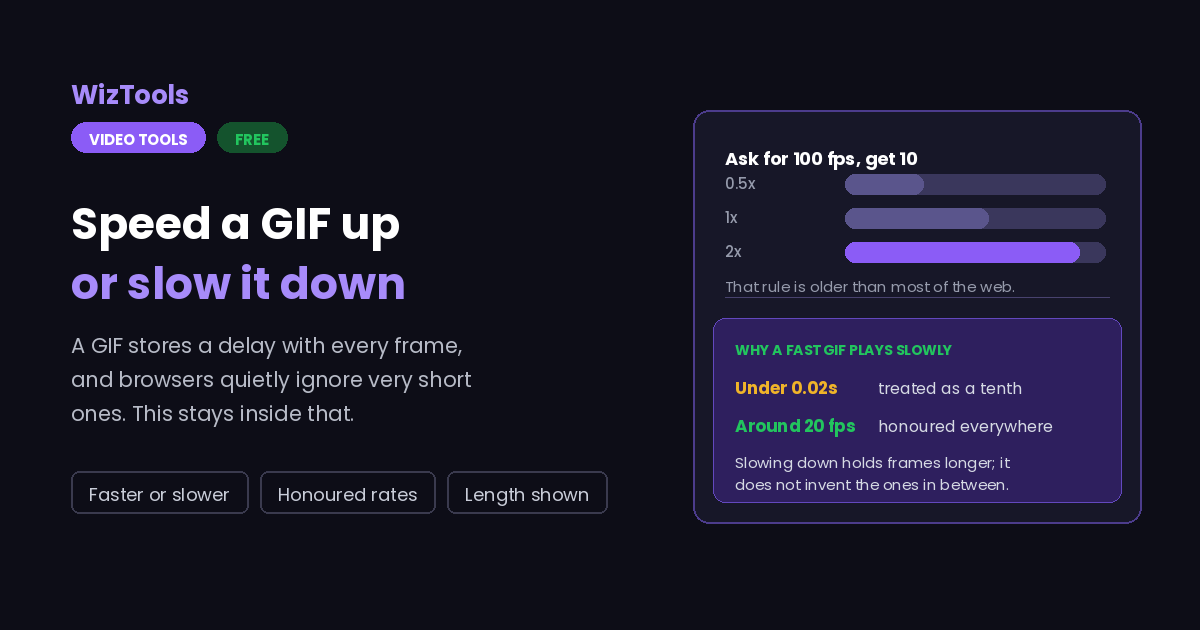
Browsers ignore very short delays. Most of them treat anything under two hundredths of a second as a tenth instead, a rule inherited from decades ago. Ask for a hundred frames a second and you get ten. That is why the frame rate here is a separate control with a sensible ceiling.
Speeding up throws frames away, and that is fine. At double speed half the frames are not needed, so the file gets smaller as well as quicker. Nothing is lost that anyone would see.
Slowing down does not add smoothness. The same frames are simply held longer, so a slowed GIF looks steppy. There is no way around that, because the missing in between frames were never recorded.
There is a real size ceiling, and it is your device, not us. The whole video has to fit in the browser's memory while it is being worked on, so roughly three hundred megabytes is comfortable on a laptop and far less on a phone. This page tells you where you stand the moment you pick a file.
The work happens on your own machine. Your video is opened by this page, not sent anywhere. That is why there is no upload bar, no queue and no waiting for a server. It is also why a big file leans on your own processor: nothing is being done for you somewhere else.
The first run downloads the engine, later runs do not. Video work needs a real encoder, and that is a thirty megabyte download the first time you press the button. Your browser keeps it, so the second video starts straight away.
Leave the tab open. All of the work is in this page, so closing it or navigating away stops the job halfway. On a phone, switching apps can do the same thing, because the system is allowed to pause a background tab.

Key Features & Capabilities

What this tool does, and what it deliberately does not.

Nothing uploaded FFmpeg runs inside your browser as WebAssembly, so the file never reaches a server.
Faster or slower From a fifth of the speed to five times it, with the new length shown before you commit.
Within what browsers honour The frame rate is a real control with a sensible ceiling, rather than a promise browsers will ignore.
A rebuilt palette The palette is made fresh from the result, so nothing degrades along the way.
Faster is smaller Speeding a GIF up discards frames nobody would see, so the file shrinks as well.
Your original is safe A new file is written and the one you dropped is never modified.

About the GIF Speed Changer

Changing the speed of a GIF is not quite the same operation as changing the speed of a video, and the difference is worth a minute because it explains a problem people hit constantly.

A video stores timestamps and a player works out the rate. A GIF stores a delay alongside every single frame, counted in hundredths of a second. That has two consequences. The first is that not every speed can be expressed exactly, so some rounding is unavoidable. The second is the real trap: almost every browser treats a delay shorter than two hundredths of a second as a tenth of a second instead, a rule inherited from the very early web and never removed. Ask for a hundred frames a second and what you get, in practice, is ten.

That is why the frame rate here is its own control with a ceiling rather than something calculated silently from the speed. Twenty frames a second looks smooth and is honoured everywhere.

The rest is straightforward. Speeding up throws away frames nobody would have seen and makes the file smaller. Slowing down holds each frame longer, which looks steppy, and keeping it smooth means duplicating frames, which makes the file bigger. Neither of those is a flaw in the tool; they are what the format is.

Frequently Asked Questions

Speeds, smoothness, browser limits and file size.

Drop it here, move the speed slider to the right and press the button. The new length is shown before you run anything.

Because most browsers treat any frame delay under two hundredths of a second as a tenth instead. Asking for a very high frame rate gets you a very low one.

No. The same frames are held for longer, so it looks steppy. The in between frames were never recorded and cannot be invented.

Usually yes. Keeping a slow GIF looking smooth means duplicating frames, and every duplicate adds to the file.

Anything between about a fifth and five times behaves predictably. Beyond that the format itself starts getting in the way.

No. Everything runs inside your browser, so the file never leaves your machine.

Other Video Tools

Advertisement Slot (Bottom Banner) Google AdSense Unit • Responsive Banner