Free Online Heart Rate Zone Calculator, Max Heart Rate and Training Zones
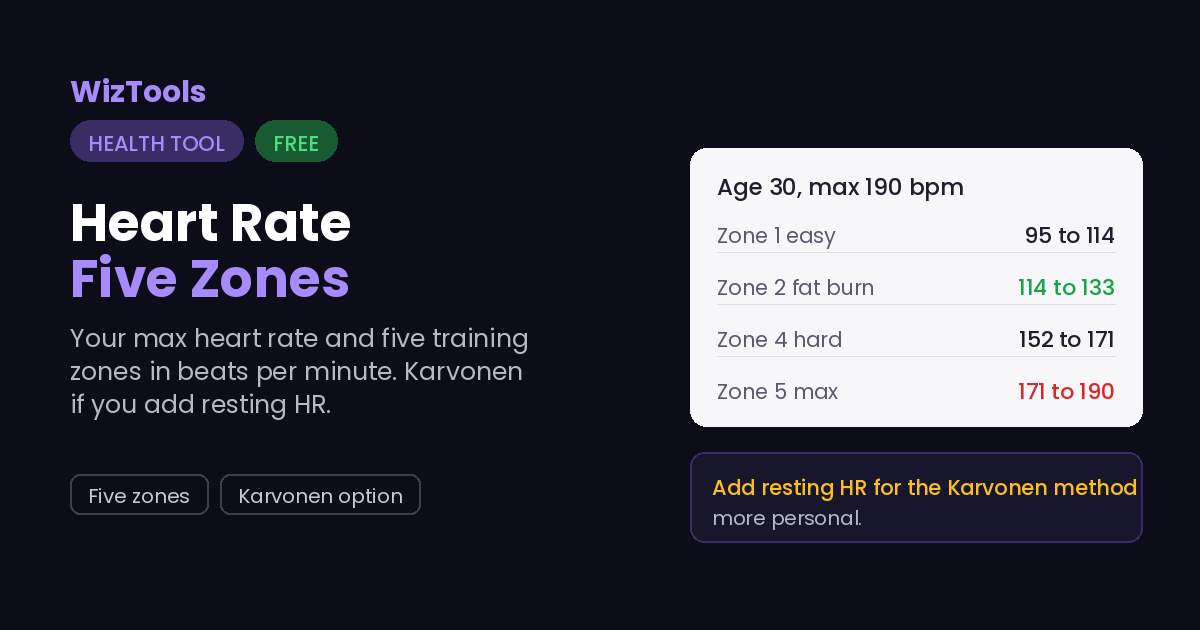
Find your five training heart rate zones. Enter your age to get your maximum heart rate and the five zones as beats per minute, from easy recovery to a maximum effort. Add your resting heart rate and it switches to the Karvonen method, which is more personal. Two max heart rate formulas are offered, and each zone says its use.
Free Forever Nothing Uploaded Five Zones As You Type
Share this tool
Advertisement Slot (Top Banner)Google AdSense Unit • Responsive Banner
Heart Rate Zone CalculatorYour max heart rate and five training zones.
Everything is worked out in your browser. No number you type is sent anywhere, and there is no account.
Your heart
Nothing is uploaded; every number stays in your browser.
years
bpm
Optional. Adds the Karvonen method, which is more personal. Measure it first thing in the morning.
Tanaka fits older adults a little better.
Result
The save button in the top bar keeps the numbers you have filled in, on this device only.
Units and numbers
Display
Size
Theme
Full screen hides the page around the tool. Press Escape, or the button in the bar, to come back.
History
Your data
Settings, history and saved setups live in this browser and nowhere else. There is no account and no server, which also means clearing them here is final.
Are you sure?
Buy Us A Coffee
Enjoying WizTools123? Help keep our server infrastructure
100% free and open for everyone.
Training zones start from your maximum heart rate, the fastest your heart can beat. The simplest
estimate is 220 minus your age; the Tanaka formula, 208 minus 0.7 times your age, fits older adults
a little better. The five zones then run from easy recovery at fifty percent up to a maximum effort
at a hundred, each suited to a different kind of training.
Karvonen makes the zones personal. If you add your resting heart rate, the tool works the
zones from your heart rate reserve, the gap between resting and maximum, instead of a flat share
of the maximum. A fitter heart has a lower resting rate and a wider reserve, so this shifts the
zones to fit you rather than an average.
The age formula is only an average. Real maximum heart rates scatter by ten to twenty beats
either side of 220 minus age, so your true maximum may differ from the estimate. A supervised
test, or a chest-strap monitor over hard efforts, is the only way to pin it down. Until then,
treat these zones as a sensible guide, and let how you feel adjust them.
Where Your Input Goes
Nowhere. And you can check that yourself.
Your age and resting heart rate are worked out in your browser and never sent anywhere.
It is all done by your own browser. Press F12, open the Network tab, and use the tool:
the page fetches its own code and nothing else. Or load the page, turn off your wifi, and
carry on. It still runs, because there was never a server in the middle.
How to Find Your Heart Rate Zones
A few steps, and nothing is uploaded.
1
Enter your ageIt sets your estimated maximum heart rate. Nothing is uploaded.
2
Add resting heart rate if you canOptional, but it switches on the more personal Karvonen method.
3
Pick a max heart rate formula220 minus age, or Tanaka, which suits older adults better.
4
Read your five zonesEach zone in beats per minute, with what it is best used for.
What to Know About Heart Rate Zones
Including the things this tool cannot do.
Zones start from your maximum heart rate. The simplest estimate is 220 minus your age; Tanaka, 208 minus 0.7 times age, fits older adults a little better. The five zones then run from easy recovery to a maximum effort, each suited to a different kind of training. The tool shows both formulas so you can compare.
Add resting heart rate for the Karvonen method. With it, the zones are worked from your heart rate reserve, the gap between resting and maximum, rather than a flat percentage of the maximum. This is more personal: a fitter heart has a lower resting rate and a wider reserve, which shifts the zones to suit you.
The age formula is a rough average. True maximum heart rates vary by ten to twenty beats either side of the estimate, so yours may differ. Only a supervised test or a chest-strap monitor over hard efforts pins it down. Until then, use the zones as a guide and let perceived effort adjust them.
Measure resting heart rate properly. Take it first thing in the morning, before getting up, when it is at its lowest and most consistent. A phone or watch reading at rest works too. A wildly high resting figure entered by mistake will throw the Karvonen zones off, so check it looks right.
Key Features & Capabilities
What this tool does, and what it deliberately does not.
Max heart rateYour estimated maximum, by either formula.
Five training zonesEach in beats per minute, with what it is for.
Karvonen optionAdd resting heart rate for zones based on your reserve.
Two formulas220 minus age, or Tanaka for older adults.
History and savedRecent results and named setups, on this device only.
Nothing uploadedYour figures stay in the browser.
About the Heart Rate Zone Calculator
Training by heart rate means working in the right zone for your goal, whether that is easy recovery, building an aerobic base, or short hard intervals. This calculator gives your estimated maximum heart rate and the five zones that hang off it, each in beats per minute and each labelled with what it is best used for, so you can match your effort to your plan.
It offers two ways to set the zones. The simple way takes a percentage of your maximum heart rate, estimated as 220 minus your age or by the Tanaka formula. The better way, if you enter your resting heart rate, is the Karvonen method, which works from your heart rate reserve, the span between resting and maximum, and gives zones that fit your own fitness rather than an average.
Everything runs in your browser with nothing uploaded and no account. The one caveat worth repeating is that an age-based maximum is only an average: real maximums vary by ten to twenty beats, so your zones are a well-founded estimate rather than an exact prescription. A supervised test gives the precise figure; until then, let how you feel fine-tune the numbers.
Frequently Asked Questions
How zones are set, and why a test beats the age formula.
By one of two age formulas: the familiar 220 minus your age, or Tanaka, which is 208 minus 0.7 times your age and fits older adults a little better. Both are averages, so your true maximum may differ by ten to twenty beats. A supervised test is the only exact way to know it.
A more personal way to set zones. Instead of taking a flat percentage of your maximum, it uses your heart rate reserve, the gap between your resting and maximum rates, so fitter hearts with lower resting rates get zones shifted to suit them. Add your resting heart rate to use it.
Roughly: zone one for warm up and recovery, zone two for fat burning and base fitness, zone three for aerobic endurance, zone four for speed and threshold work, and zone five for short maximum efforts. Most easy training sits in zones one and two.
First thing in the morning, before you get up, when it is lowest and steadiest. Count your pulse for a minute, or read it from a watch or phone at rest. Enter that figure to switch the zones to the Karvonen method.
No. Everything is worked out in your browser, with history and saved setups on this device only. You can confirm it in the Network tab or by working offline.