WizTools123
WizTools123
Free Online Tools

Tool Categories


PDF Tools New Tool

Free Online Reorder PDF Pages, Drag Thumbnails, Move or Reverse

Put PDF pages in the right order by dragging them. Move a single page, reverse the whole document, or shuffle a scan that came out back to front, watching the thumbnails as you go. Download the reordered file when it looks right. Everything happens in your browser and nothing is uploaded.
Free Forever Drag or Type Nothing Uploaded No Quality Loss
Free Online Reorder PDF Pages, Drag Thumbnails, Move or Reverse
Share this tool
Advertisement Slot (Top Banner) Google AdSense Unit • Responsive Banner
Reorder PDF Pages Drag and drop your PDF here to rearrange its pages. It is opened by your browser, not by a server. Select a PDF File Up to 200 MB • 5,000 pages • nothing is uploaded
document.pdf
Drag the pages

This is the part that makes reordering easy. The page renderer is a large download, so it only loads when you ask for it. You can also type the order below without it.

Drag a page onto another, or use its arrows.
Common fixes
Hover or tap a button to see what it is for.
Or write the order
Ranges, single pages, or the words odd, even, first and last. Anything you leave out is added at the end.
Output
.pdf

Done
Buy Us A Coffee

Enjoying WizTools123? Help keep our server infrastructure 100% free and open for everyone.

Buy Us A Coffee
Sponsored Content (Below Tool) Google AdSense Placement

What Moves With the Page, and What Does Not

Worth knowing before you send the file on.

When a page moves Follows it? Why
The text, images and layout Yes They are the page itself
Its rotation Yes Stored on the page
Form fields on that page Yes Attached to the page
The page number printed on it Moves, but does not update It was drawn on when the file was made
Links and bookmarks pointing to it Often not They point at a position, not the page
None of this is specific to this tool. Every program that rearranges PDF pages behaves the same way, including Acrobat, because the printed number is part of the page image and a bookmark records a position in the document. If continuous numbering matters, the document needs to be regenerated from whatever produced it rather than rearranged.

Writing the Order

Everything below assumes a 6 page document. Anything you leave out is added at the end, so a partial order is a shortcut rather than a mistake.

What you type What it means The new order
6,5,4,3,2,1 The whole document backwards 6, 5, 4, 3, 2, 1
3,1,2 Three pages named, the rest follow 3, 1, 2, 4, 5, 6
4-6,1-3 The second half moved to the front 4, 5, 6, 1, 2, 3
2 One page pulled to the front 2, 1, 3, 4, 5, 6
odd,even All the odd pages, then all the even 1, 3, 5, 2, 4, 6
last,1-5 The back page moved to the front 6, 1, 2, 3, 4, 5
1,1,2 A repeat is only counted once 1, 2, 3, 4, 5, 6

Spaces do not matter, and neither does the separator: commas, spaces and semicolons all work. A page listed twice is only used once, and a page number larger than the document is ignored.

Is It Safe to Reorder a PDF Online?

A fair question, and the answer is checkable.

What happens to your file Most PDF sites This page
Where the file is opened On their server In your browser
Who else can read it Whoever runs the server Nobody, it never left
What happens afterwards Deleted later, they say There is nothing to delete
Can you verify the claim No, you have to trust it Yes, see below
Check it yourself. Press F12 to open your browser tools and go to the Network tab. Drop a PDF in and reorder it. You will see the page fetch its own code and nothing else: your file is never sent. For a stronger test, load this page, turn off your wifi, and reorder a document anyway. It still works, which would be impossible if a server were doing the job.

How to Reorder PDF Pages

Drop, drag, download. Your original is never touched.

1
Drop your PDF on the page Drag it in or click to browse. It is opened by your browser, so nothing is uploaded and the page keeps working with the connection off.
2
Turn on the page previews On this tool the previews are the point. Once they are on you can see every page and drag them into position.
3
Drag pages where you want them Grab a page and drop it on another to move it there. On a phone, or if you would rather not drag, each page has arrows to nudge it one place at a time.
4
Or type the order instead For a long document it is faster to write it: 4-6, 1-3 puts the second half first. Anything you leave out is added at the end.
5
Download the reordered file A new document is built with the pages in your order. Your original stays exactly as it was.

What to Know Before You Rearrange

Including the things this tool cannot do.

Every page always comes with you. Reordering moves pages around, it never drops them. If the order you type leaves some out, the missing ones are added at the end and the tool tells you it did that. To actually remove a page, use the delete pages tool instead.
Numbers printed on the pages do not follow. Move page 5 to the front and it still has "5" printed on it. Those numbers are part of the page, put there when the document was made, and nothing that rearranges pages can rewrite them.
Internal links and bookmarks may end up pointing at the wrong page. A contents page that says "see page 12" is referring to a position, and you have just changed what sits there. This is true of every tool that reorders pages, and it is worth checking before you send the file on.
Nothing is re-drawn. Pages are copied into their new positions exactly as they were, so text stays selectable, images keep their resolution, and the file comes out roughly the same size it went in.
Your file never leaves this page. There is no upload, no server and no account. Open your browser tools, watch the network tab, and reorder a document: nothing goes out.
Previews are what make this usable. You can type an order without them, but for anything longer than a few pages, seeing the pages is the only sensible way to know where things should go. That is why the preview button is right at the top here.
A password protected PDF has to be opened first. This tool will not try to break one, and it says so rather than failing silently. Unlock it, then come back.
A digital signature will not survive. That is how PDF signatures work rather than a limitation here: the signature covers the whole document, so changing the page order voids it.
Your original file is not touched. The result is a new document that downloads separately, so a wrong order costs you nothing except doing it again.

Key Features & Capabilities

What this tool does, and what it deliberately does not.

Drag pages into place See every page and drop it where it belongs. Arrows on each page do the same job one step at a time, for phones and for anybody who dislikes dragging.
Or write the order On a long document typing is faster: 4-6, 1-3 puts the second half first. Ranges, single pages and the words odd, even and last all work.
Fixes for real scans One button reverses a back-to-front stack, another interleaves a batch where all the fronts were scanned before all the backs.
Never loses a page If your order leaves pages out they are added at the end rather than dropped, and the tool says so instead of quietly shortening your document.
Nothing is re-drawn Pages are copied into their new positions exactly as they were, so text stays selectable and images keep their resolution.
Nothing is uploaded All of it runs in your browser. No server, no account, no queue, and it keeps working offline once the page has loaded.
No watermark, no page cap The file you get carries nothing this site added, and there is no daily limit waiting to appear after the third document.
Says what it cannot do Printed page numbers, internal links and digital signatures are all explained on this page rather than discovered when the result disappoints you.

About the Reorder Pages Tool

Reordering pages is the PDF job that most obviously wants to be done by looking rather than by typing. You know the appendix belongs at the back and the summary at the front, but you do not know that the appendix is pages 14 to 19 until you can see them. That is why the previews on this page are not an optional extra tucked away somewhere: they are the tool. Turn them on, and every page becomes a thumbnail you can pick up and drop where it belongs.

Typing the order is still there, and on a long document it wins easily. Writing 4-6, 1-3 moves the second half to the front in one go, and something like 200-400, 1-199 would be miserable to do by dragging. The rule that makes typing safe is that anything you leave out is added at the end rather than thrown away, so a partial order is a shortcut rather than a mistake. Type 7 and page 7 moves to the front while everything else stays as it was.

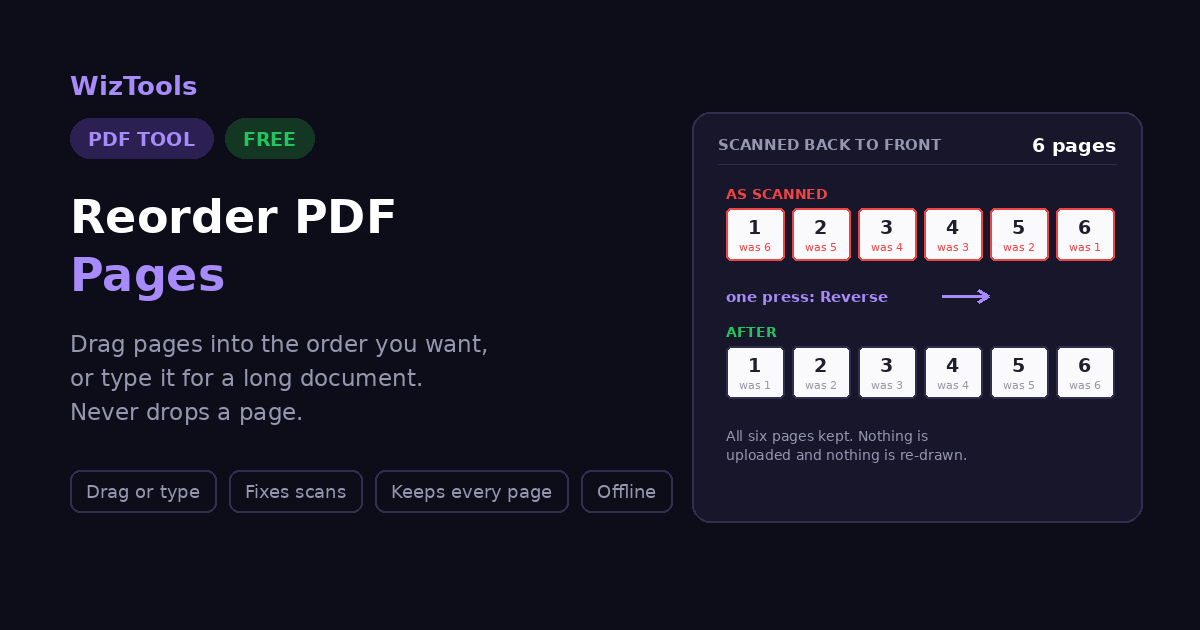
The scanning fixes are here because scanners create the same two messes over and over. A stack fed in the wrong way round gives you the whole document backwards, which one button undoes. Scanning all the fronts and then all the backs gives you every odd page followed by every even page, which is a different problem and needs the two halves zipped back together rather than reversed. Both take one press, and both are far more common than they ought to be.

Two things are said plainly here that most tools leave you to discover. Page numbers printed on the pages do not renumber, because they were drawn onto the page when the document was made and moving a page carries its number along. And links, bookmarks and contents entries point at positions, so rearranging pages can leave them aiming at the wrong one. Neither is a shortcoming of this tool in particular; both are true of anything that reorders a PDF, and knowing beforehand is better than finding out after you have sent the file.

Frequently Asked Questions

Everything worth knowing before you rearrange a document.

Drop the file on this page and turn on the previews. Every page appears as a thumbnail, and you drag any one of them onto another to move it there. If you would rather not drag, each page has arrows that nudge it one position at a time. For a long document it is quicker to type the order instead, for example 4-6, 1-3 to put the second half first. Then download the result. Nothing is installed and nothing is uploaded.

No, and the tool is built so it cannot. Reordering is a rearrangement, so every page in your document always ends up in the new one. If the order you type happens to leave some pages out, they are appended at the end and you are told that happened, rather than being silently dropped. If you actually want to remove a page, that is a different job and there is a separate tool for it.

No, and no tool that rearranges pages can do this. The numbers you see are drawn onto the page itself, put there when the document was created. Moving the page moves the number with it, so a page that says "5" still says "5" wherever it lands. If continuous numbering matters, the document has to be regenerated from whatever produced it, or numbers added afterwards as a separate step.

They can end up pointing at the wrong place, and it is worth knowing before you send the file on. A link or a contents entry refers to a position in the document, and reordering changes what sits at each position. This applies to every tool that rearranges PDF pages, not just this one. Plain text is unaffected; it is only clickable links, bookmarks and cross references that can drift.

Yes, that is what the Reverse button is for: one press and the whole document runs the other way. There is also a fix for the other common scanning mess, where you scan all the fronts, then all the backs, and end up with pages 1, 3, 5 followed by 2, 4, 6. Interleave halves zips those two halves back together into the right sequence.

Type its number on its own. Writing 7 puts page 7 first and everything else keeps its existing order behind it, because anything you do not mention is added afterwards. With previews on you can also just drag that page to the first position, which is usually easier when you can see what you are moving.

It depends entirely on whether the file is uploaded. Most PDF websites send your document to a server, do the work there, and promise to delete it later. That is a promise about their behaviour. This page never sends the file anywhere. Open your browser developer tools, watch the Network tab, and reorder a document: nothing leaves. You can also load the page, disconnect from the internet, and it still works.

No. Pages are copied into their new positions exactly as they were rather than being redrawn, so text stays selectable and searchable, images keep their original resolution, and vector graphics stay sharp. The file size comes out close to what it was, with only small differences from how the document is rebuilt internally.

Yes, though not by dragging. Previews are limited to 150 pages here because a grid of several hundred thumbnails is neither quick to draw nor practical to drag around. Beyond that, type the order instead, which is the sensible approach at that length anyway: something like 200-400, 1-199 is far faster than moving anything by hand.

Nothing. The result is a new document that arrives as a separate download, and the file you dropped in is left exactly as it was. A wrong order costs you nothing except doing it again, so there is no reason to be nervous about experimenting.

Other PDF Tools

Advertisement Slot (Bottom Banner) Google AdSense Unit • Responsive Banner