

Free Online Barcode Generator, Code 128, EAN, UPC & Scanner Tools
Create and read barcodes online for free. Generate Code 128, Code 39, EAN-13, EAN-8, UPC-A and ITF-14 barcodes for stock labels, shelf tags and products, then download them as PNG or SVG. Read a barcode back from your camera or a photo and check the number before you print a whole sheet.
Choose a Barcode Tool
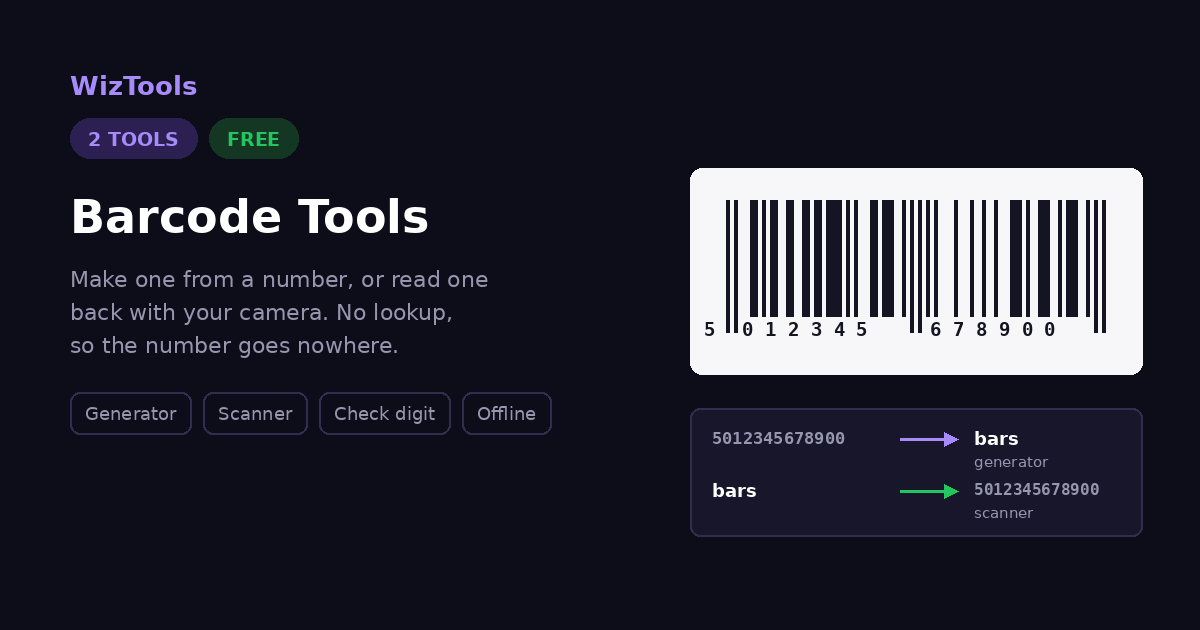
One turns a number into bars, the other turns bars back into a number.
Enjoying WizTools123? Help keep our server infrastructure 100% free and open for everyone.
Which Tool Do I Need?
Find the sentence that sounds like you.
| What you are trying to do | Tool | Why that one |
|---|---|---|
| I have a barcode in front of me and I want its number | Barcode Scanner & Reader | That is reading one. Use the camera, or a photo you already took. |
| I have a number and I need a barcode I can print | Barcode Generator | That is making one. Take the SVG or PDF for anything printed. |
| I am typing product codes into a spreadsheet from photos | Barcode Scanner & Reader | The check digit is redone here, so you can tell a good read from a bad one. |
| I want to label my own shelves or stock boxes | Barcode Generator | Code 128 takes letters as well as numbers, which is what you want for your own labels. |
| I want to know what product a barcode belongs to | Neither | Neither tool can. A barcode holds digits and nothing else, and finding the product means sending those digits to somebody's database. That is exactly what is not done here. |
How These Barcode Tools Work
The same four steps, whichever one you pick.
Why Use These Instead of the Usual Barcode Sites
The things that are actually different, not a list of adjectives.
About WizTools Barcode Tools
A barcode is a number written so a machine can read it quickly and get it right. The black and white bars on a tin of beans are thirteen digits, and those thirteen digits are the entire contents. There is no brand in there, no price, no weight, no country and no expiry date. Everything a till knows about that tin, it knows because the number was looked up in a database the shop keeps.
That is worth saying because of what it means for the tools. Making a barcode is the easy half: you have a number, and the bars are just a way of writing it down that a scanner can follow, with a final digit calculated from the rest so that a misread gets rejected instead of ringing up somebody else's product. Reading one is the same thing backwards, and it ends with a number rather than with a product, because a number is all there ever was.
The thing most online readers add at that point is a lookup, and it changes what the tool is. To show you a product name they have to send your number to a service that keeps a database of them, which is a different activity from reading a barcode and is not usually mentioned. Neither tool here does that, so you get digits and privacy instead of a name and a request you did not make.
And the claim that will not go away, repeated in forwarded messages every year: the first digits do not tell you where something was made. They identify the GS1 office where the company bought its numbers. Companies register where they are based and manufacture wherever they like, so a barcode starting 50 says a company signed up in the United Kingdom and says nothing at all about a factory. Country of origin is printed on the packaging in words, and that is the statement that means something.
Frequently Asked Questions
About barcodes in general. Each tool has its own answers too.
Every Other Category
17 more sets of tools on the site. All free, all in your browser.