WizTools123
Free Online Tools

Tool Categories


Developer Tools New Tool

Free Online Sitemap XML Generator from a List of URLs

Paste your URLs one per line and read back a sitemap that validates, with lastmod, changefreq and priority set for every URL or taken from extra columns. Ampersands and non-ASCII characters are escaped properly, and long lists can be split with a sitemap index written for you.
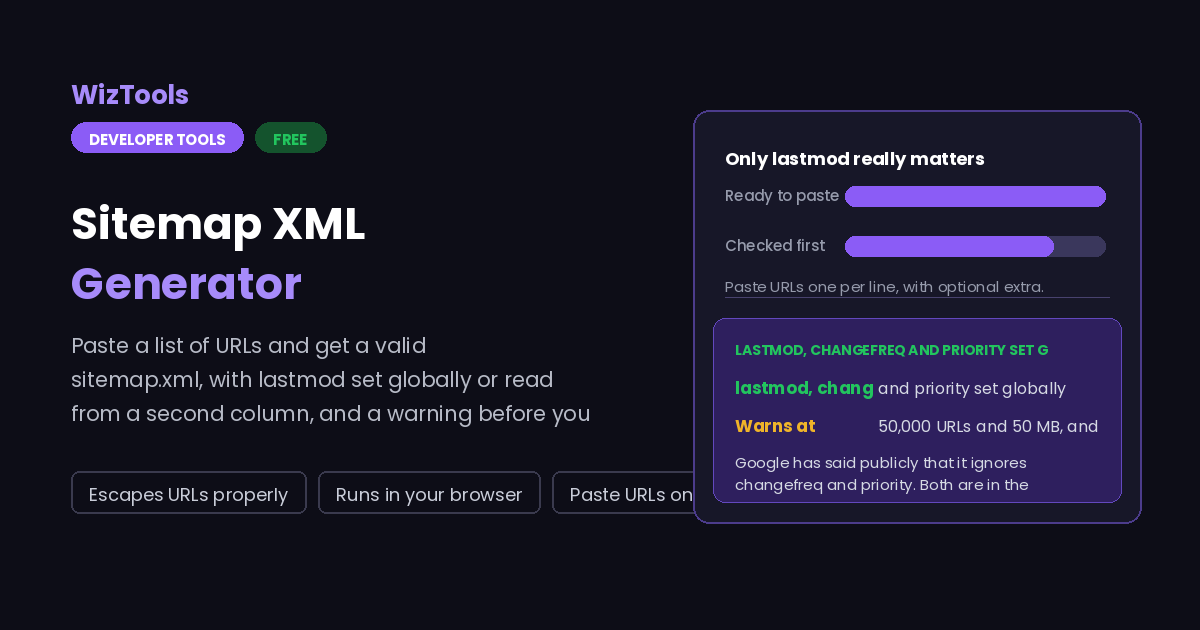
Free Forever Nothing Uploaded Escapes URLs properly Runs in your browser
Free Online Sitemap XML Generator from a List of URLs
Share this tool
Advertisement Slot (Top Banner) Google AdSense Unit • Responsive Banner
Sitemap XML Generator Everything happens in this tab. Nothing you paste is sent anywhere.
Your URLs
sitemap.xml
Output
For every URL
Splitting

0 URLs 1 file 0 bytes 0 skipped

Buy Us A Coffee

Enjoying WizTools123? Help keep our server infrastructure 100% free and open for everyone.

Buy Us A Coffee
Sponsored Content (Below Tool) Google AdSense Placement

How to Build a Sitemap

A few steps, and nothing is uploaded.

1
Paste your URLs One per line, absolute if you can. If they are relative, put your domain in the Base URL field and they will be joined to it.
2
Set lastmod if you know it Today's date for everything, a fixed date, or a date per URL in a second column. Of the three optional fields this is the only one worth the effort.
3
Watch the counts The line under the controls shows how many URLs, how many bytes and how many were skipped. It warns before you reach the 50,000 and 50 MB limits.
4
Split if you need to Turn on splitting and each file is written out with a marker line above it, followed by a sitemap index that lists them all.

What to Know About Sitemaps

Including which of the three optional fields is worth setting.

Google has said publicly that it ignores changefreq and priority. Both are in the sitemap protocol, both are accepted, and neither changes how often a page is crawled. Priority is relative within your own sitemap and never competes with other sites, which makes setting everything to 1.0 pointless in a way that is not obvious. They are here because the protocol has them and some other crawlers still read them, not because they will help you.
lastmod is the one that counts, and only if it is honest. Google uses it to decide what to recrawl, but a file that reports today's date for every URL on every build teaches the crawler to ignore the field entirely. Set it from the date the content actually changed, and leave it out rather than fake it.
A sitemap helps discovery, not ranking. It tells a crawler that a URL exists; it does not make that URL rank, and it does not guarantee indexing. Pages that are reachable through normal navigation are usually found anyway. Sitemaps earn their keep on large sites, on new sites with few links, and for pages that are deep in the structure.
This does not crawl your site, so it cannot find your URLs for you. You have to supply the list, from your CMS, a database query, a log file or a crawler you run yourself. Nothing here fetches a page, checks that a URL returns 200, or notices that a URL is a redirect, and a sitemap full of redirects and 404s is worse than a short accurate one.

Key Features & Capabilities

What this tool does, and what it deliberately does not.

Valid sitemap XML The right namespace, the right elements, in the right order.
Columns per URL lastmod, changefreq and priority read from the same line.
Escaped properly Ampersands, angle brackets and non-ASCII characters all handled.
Splitting and an index Long lists split into files, with a sitemap index written too.
Counts and warnings URLs, bytes, duplicates and anything skipped, as you type.
Nothing is uploaded Your URL list stays in the tab. The page works offline.

About the Sitemap Generator

A sitemap is a list of the URLs on a site, wrapped in a small amount of XML, that tells a crawler what exists. The format is simple enough to write by hand for ten pages and completely impractical for ten thousand, which is where a generator comes in. The awkward parts are not the tags: they are escaping, the two size limits, and knowing which optional fields are worth filling.

This page takes the list you already have, from a database query, a CMS export or a spreadsheet column, and turns it into a file. Extra columns on a line are recognised by what they look like rather than by their position, so a date is treated as lastmod and a number between nought and one as priority no matter which order you put them in.

Escaping is the part most hand-written sitemaps get wrong. A URL with a query string almost always contains an ampersand, and a bare ampersand makes the whole document invalid, so every URL here is escaped for XML. Non-ASCII characters are percent-encoded, because the protocol wants URLs in their escaped form. Everything else is honesty about the limits: the counts are shown as you type, and the 50,000 URL and 50 MB ceilings are announced before you cross them rather than after.

Frequently Asked Questions

Limits, lastmod, indexes and what a sitemap does not do.

Not for Google, which has said plainly that it ignores both. Priority is only relative to your own other URLs and never affects how you compare with other sites. Some smaller crawlers still read them, so they are written if you set them, but leaving both out costs you nothing.

Fifty thousand URLs and fifty megabytes uncompressed per file. Beyond either, split into several sitemaps and list them in a sitemap index, which itself may hold fifty thousand sitemaps. The counts on this page show both numbers as you type so you know when you are close.

No. If every URL claims to have changed on every build, the field stops carrying information and crawlers learn to disregard it. Use the date the page content actually changed. If you do not have that date, leaving lastmod out is better than inventing one.

Anywhere on the host, though the root is conventional. Add a Sitemap: line to your robots.txt pointing at its full URL, and submit it in Search Console as well. A sitemap can only list URLs on the same host unless you have verified ownership of the others.

It gets them discovered, which is a different thing. Indexing depends on whether the page is worth indexing, and a sitemap listing thin, duplicated or redirecting URLs can make things worse by spending crawl budget on them. Keep the list to pages you would be happy to see in search results.

Every Other Developer Tool

88 more tools in this set. All free, all in your browser.

Advertisement Slot (Bottom Banner) Google AdSense Unit • Responsive Banner