
WizTools123
WizTools123
Free Online Tools

Tool Categories


Text Tools New Tool

Free Online Find and Replace Text, Whole Words, Case, Regex & Multiple Rules

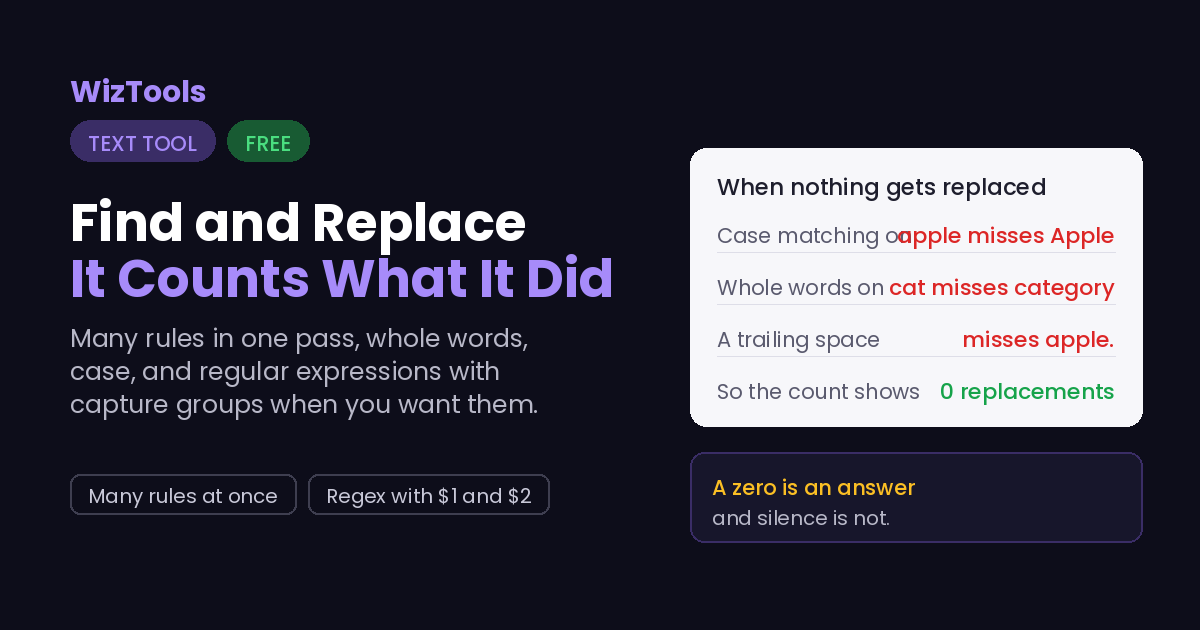
Replace one thing with another across a whole text, or run a list of replacements in one pass. Match whole words only, respect case, or switch on regular expressions with capture groups when the pattern is not a fixed string. Every run tells you how many replacements it made before you copy anything.
Free Forever Nothing Uploaded Regex Support Many Rules at Once
Free Online Find and Replace Text, Whole Words, Case, Regex & Multiple Rules
Share this tool
Advertisement Slot (Top Banner) Google AdSense Unit • Responsive Banner
Find and Replace Text Everything happens in this tab. Nothing you paste is sent anywhere.
Your text
0 characters 0 words 0 lines
After the replacements
0 characters 0 lines
Find replace with
  Rules run top to bottom, in one pass.
How to match

In this mode \d is any digit, \s any space, . any character, and + means one or more. Brackets capture, so (\w+) (\w+) with $2 $1 swaps two words around.

0 replacements made, from 0 rules.

Buy Us A Coffee

Enjoying WizTools123? Help keep our server infrastructure 100% free and open for everyone.

Buy Us A Coffee
Sponsored Content (Below Tool) Google AdSense Placement

When Nothing Gets Replaced

Four reasons, and all four are visible on this page.

What happened Why
Case Looking for apple with case matching on will not find Apple. Case matching is off by default here, so this one usually shows up when you switched it on.
Whole words With whole words on, cat does not match inside category. That is the point of it, and it is also why a partial word stops being found.
A stray space Searching for apple  with a trailing space misses apple. at the end of a sentence. Spaces inside the search box are real characters.
Regex mode With regular expressions on, . means any character and ( starts a group. Text with brackets in it needs them escaped, or the switch turned off.
This is why the number of replacements is always shown, including zero. A find and replace that silently does nothing looks exactly like one that worked, until you notice the text is unchanged. The count under the rules is the fastest way to tell the difference, and a zero there tells you to look at the four rows above.

Where Your Text Goes

Nowhere. And you can check that yourself.

Find and replace usually runs over something private, and this page never receives it. The text is read and changed by your own browser. Press F12, open the Network tab, and use the tool: the page fetches its own code and nothing else. Or load the page, turn off your wifi, and carry on working. It still runs, because there was never a server in the middle.

How to Find and Replace Text

Four steps, and your original text is never changed.

1
Paste your text On the left. Your original stays there untouched while the result builds on the right.
2
Fill in a rule What to look for, and what to put instead. Leaving the second box empty deletes what you found.
3
Add more rules if you need them They run top to bottom in a single pass, so a later rule works on the result of the earlier ones.
4
Check the count, then copy The number of replacements is shown under the rules. A zero means the match never happened, not that the tool did nothing.

What to Know Before You Replace

Including the things this tool cannot do.

Rules run in order, and a later rule sees what the earlier ones did. Replacing cat with dog and then dog with fox turns every original cat into a fox, which is almost never what was wanted. When two rules touch the same words, put the more specific one first, or do them in two passes with the Use as input button.
Without regular expressions, everything you type is a literal. A full stop means a full stop, a bracket means a bracket, and a dollar sign in the replacement stays a dollar sign. That is the opposite of what most find and replace boxes do, and it is the safer default: text with punctuation in it works without escaping anything.
With regular expressions on, capture groups become available and so do the mistakes. Brackets capture a piece, and $1 and $2 in the replacement put those pieces back, so (\w+) (\w+) with $2 $1 swaps two words. A pattern that does not compile is reported with the message from the browser rather than being quietly ignored.
Replacing nothing is not an error, and neither is replacing everything. This tool will happily delete every instance of a common word if you leave the replacement empty, and it does not ask twice. Your original text stays in the left box, so the way back is to look at it rather than to undo.

Key Features & Capabilities

What this tool does, and what it deliberately does not.

Many rules, one pass Add as many find and replace pairs as you need; they run top to bottom.
Regular expressions With capture groups, and a clear message when a pattern does not compile.
Whole words and case Match cat without touching category, or match Apple but not apple.
It counts what it did The number of replacements is always shown, including zero.
Live as you type The result updates while you edit the rules, so you see the effect before you copy.
Nothing uploaded The text and the rules both stay in your tab.

About the Find and Replace Text

Find and replace is in every editor, and it is usually the wrong shape for the job. It changes the document in place, it does one rule at a time, and it tells you nothing until you look. When you have twenty substitutions to make across a block of text, that becomes twenty rounds of dialog boxes and a lot of hoping.

This does the whole set at once. Each rule is a row, the rules run top to bottom in a single pass, and the result appears beside your original rather than on top of it. The number of replacements is on screen the whole time, which turns the most common problem with find and replace into a number you can read.

The default is deliberately literal. Nothing you type in the search box is treated as a pattern unless you switch on regular expressions, so a search for a price with a dollar sign in it, or a sentence with brackets, works without escaping anything. When you do want patterns, the switch is right there and the capture groups work the way they do everywhere else.

Frequently Asked Questions

Why a replacement misses, and what changes when regex is on.

Put what you want gone in the find box and leave the replace box empty. Everything that matches is removed, and the count tells you how many went.

Because rules run in order and each one works on the result so far. Replacing cat with dog and then dog with fox makes every original cat a fox. Reorder the rules, or run the first set, press Use as input, and then run the second set.

Not unless regular expressions are switched on. By default a full stop, a bracket, a dollar sign and everything else are treated as ordinary characters. Turn the switch on and they become pattern syntax, which is when escaping matters.

Switch on regular expressions, put brackets around the part you want to keep, and use $1 for the first bracket, $2 for the second. Searching for (\w+) (\w+) and replacing with $2 $1 swaps every pair of words. Outside regex mode, $1 stays as the literal text $1.

In regex mode, yes, using \n for a line break. In plain mode you cannot type a line break into a single line input box, so joining the lines first with the Remove Line Breaks tool is the usual way round it.

Other Text Tools

Advertisement Slot (Bottom Banner) Google AdSense Unit • Responsive Banner