WizTools123
Free Online Tools

Tool Categories


Math Tools New Tool

Free Online Ratio Calculator, Simplify, Scale & Solve for X

Simplify a ratio to its smallest whole numbers, scale one up or down, or solve for the missing part when three of the four numbers are known. It handles ratios with three parts as well, and shows each answer as a fraction and a percentage share so you can see how the split falls.
Free Forever Nothing Uploaded Share of the Whole Working Shown
Free Online Ratio Calculator, Simplify, Scale & Solve for X
Share this tool
Advertisement Slot (Top Banner) Google AdSense Unit • Responsive Banner
⚖️ Ratio Calculator Simplify, solve or share out · up to six parts

The sum runs in your browser. Nothing you type is sent anywhere.

⚖️ What do you need?

Colons between the parts, up to six of them. Decimals like 1.5:2 are fine, and "3 to 2" or "3/2" work too.
Two ratios that are equal, with one number missing
: = :
Fill in the three you know and the fourth appears. This is the cross multiply you were taught, and the working shows it.
The parts are added up to find how many shares there are, then the amount is split between them.
Try one of these
Answer
—

What each part is of the whole

Part In the ratio Of the whole As a percentage Amount
Buy Us A Coffee

Enjoying WizTools123? Help keep our server infrastructure 100% free and open for everyone.

Buy Us A Coffee
Sponsored Content (Below Tool) Google AdSense Placement

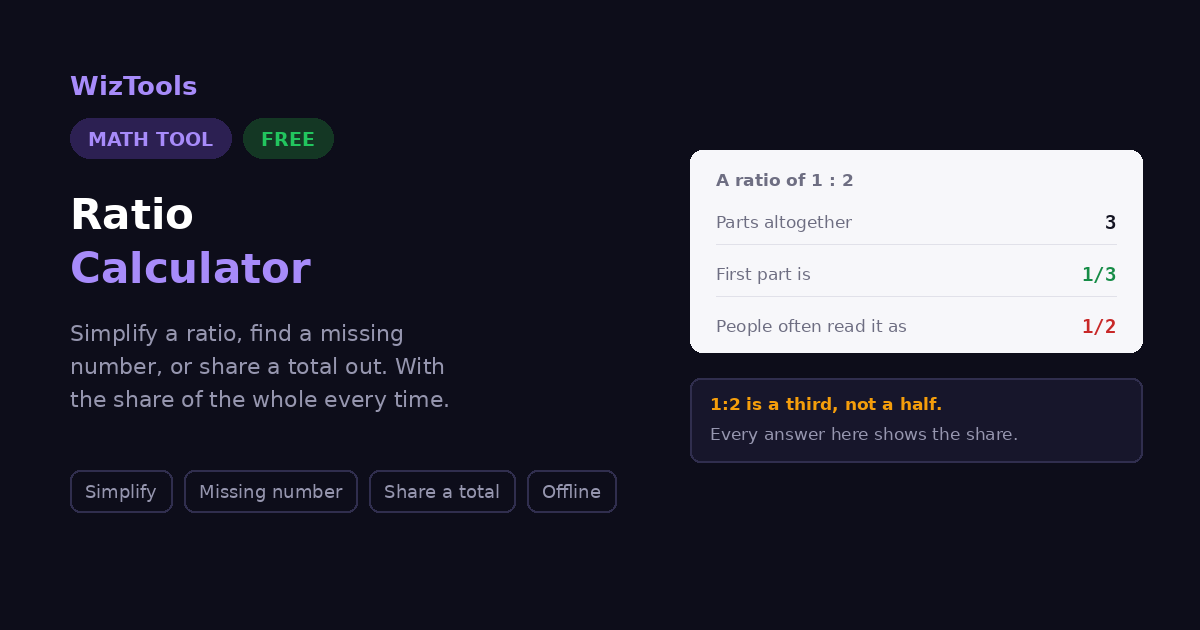
A Ratio of 1:2 Is a Third, Not a Half

The mistake that ruins squash, concrete and quite a few bills.

A fraction compares a part with the whole. A ratio compares parts with each other. That is the entire difference, and it is why a ratio of 1:2 looks like a half and is actually a third: there is one part, and two parts, so three parts altogether, and the first one is one of those three.

The ratio Parts in total First part is What people often think
1:1 2 a half correct, this is the easy one
1:2 3 a third a half
1:4 5 a fifth a quarter
3:2 5 three fifths three halves
1:2:3 6 a sixth nobody is sure, which is fair
The rule is simple once you have it: add all the parts first. That total is the bottom of every fraction. It is why the table under the calculator always shows what share of the whole each part is, on every answer, whether you asked for it or not.

The Three Things People Mean by "Ratio Calculator"

They are different questions, so they get different panels.

You want to The method An example
Simplify Divide every part by their highest common factor 12:18:24 ÷ 6 = 2:3:4
Find the missing one Cross multiply, then divide 3:4 = 15:x → x = 4×15÷3 = 20
Share a total Add the parts, divide the amount by that, multiply back 500 as 3:2 → 5 parts of 100 → 300 and 200
Scale a recipe The same as finding the missing one serves 4 needs 300g, so serves 6 needs 450g
3:2 and 2:3 are not the same ratio. Nothing can work out which way round you meant, so the parts are always shown back to you in the order you typed them. If a drawing says 1:200 and you type 200:1, everything after that is wrong and the arithmetic will be perfectly correct.
A ratio has no units, which is its whole usefulness. 2:1 is 2:1 in grams, litres or people, so it survives being scaled up and down. The price of that is that mixing units up produces an answer that looks completely fine.

How to Use the Ratio Calculator

Four steps, and the third one is the one that catches people.

1
Pick what you are trying to do Simplify a ratio you already have, find a missing number in a pair of equal ratios, or share a total out in a given ratio. They are three different questions and they get three different panels.
2
Write the ratio with colons Like 3:2, or 12:18:24, or 1.5:2. Up to six parts, and decimals are fine because they are scaled up to whole numbers before anything is simplified.
3
Read the share of the whole, not just the ratio Every answer here also tells you what fraction and what percentage of the total each part is. That line is there because 1:2 is one third, and people read it as one half more often than they would believe.
4
Check the working The number it divided by to simplify, or the cross multiplication, or the total number of parts it split the amount into. All of it is shown rather than assumed.

What to Know Before You Start

Including the things this tool cannot do.

1:2 is one third, not one half. This is the single most common mistake with ratios and it catches people who are perfectly comfortable with fractions. A ratio of 1:2 means one part and two parts, so three parts altogether, and the first one is a third of the whole. If a squash bottle says one part to four, that is one fifth squash, not one quarter. Every answer on this page shows the share of the whole for exactly this reason.
The order is part of the answer. 3:2 and 2:3 are different ratios, and writing them the wrong way round is easy when you are copying from a recipe or a drawing. Nothing here can tell you which way round you meant, so it always shows the parts back to you in the order you typed them.
A ratio has no units, and that is the point. 2:1 is 2:1 whether it is grams, litres or people, which is what makes ratios useful for scaling. But it also means the tool cannot check that you have mixed units up. Two cups to one gram will simplify perfectly happily and mean nothing.
A part cannot be zero when you are dividing by it. Finding a missing number in a:b = c:d needs b and c to be non-zero, because the answer comes from multiplying and dividing. You get told rather than shown something wrong. A ratio like 3:0 is allowed when you are simply simplifying, because it means all of one and none of the other.
Sharing a total does not always come out even. Split 100 in the ratio 1:1:1 and each share is 33.333 recurring. The shares are shown to full precision rather than rounded silently, because rounding three shares to 33.33 each leaves a penny unaccounted for, and that penny is exactly the sort of thing that causes an argument.
The sum runs on your own machine. There is no server. Nothing you type is uploaded, and it keeps working with the network switched off.

Key Features & Capabilities

What this tool does, and what it deliberately does not.

Three jobs, one tool Simplify a ratio, find a missing number in a pair of equal ratios, or share a total out. Most ratio calculators do one of these, and people then use the wrong one because it is the one in front of them.
The share of the whole, every time Each part as a fraction and as a percentage of the total, alongside the simplified ratio. This is the line that stops 1:4 being read as a quarter, and almost nothing else shows it.
Up to six parts, and decimals work Ratios like 1:2:3:4 for a mix, or 1.5:2 straight off a drawing. Decimals are scaled up to whole numbers before anything is simplified, so nothing is lost on the way.
The working is shown The highest common factor it divided by, or the cross multiplication for a missing number, or the number of parts the total was split into. Enough to check the answer rather than take it.
Keeps what you were doing Save a ratio you come back to, or log one to history and load it straight back. Both live in this browser only.
No account, no upload, no watermark The whole thing is the page you are reading, and it works offline once loaded.

About the Ratio Calculator

A ratio compares parts with each other. A fraction compares a part with the whole. That one sentence is the difference, and almost every mistake people make with ratios comes from sliding between the two without noticing. A ratio of 1:2 has three parts in it, so the first is one third. Read as a fraction it looks like a half, and a lot of squash has been made too strong on the strength of that.

Once you hold on to the idea of counting all the parts, the rest is straightforward. To simplify, divide every part by the highest common factor: 12:18:24 all divide by 6, giving 2:3:4. To share something out, add the parts to find how many shares there are and give each part that many: 500 in the ratio 3:2 is five shares of 100, so 300 and 200. To find a missing number in two equal ratios, cross multiply, which is just the observation that if two fractions are equal then so are their cross products.

Ratios turn up wherever something has to keep its shape while changing size. Screen dimensions, map scales, concrete mixes, dilution rates, recipes for a different number of people, splitting a bill by contribution. In all of those the useful property is that a ratio carries no units, so 2:1 is 2:1 whether you are counting grams or people. The cost of that is that nothing can check you have not mixed your units up along the way.

So this page does the three jobs separately rather than pretending they are one, and every answer comes with the share of the whole written out beside it. That line is the whole reason it exists.

Frequently Asked Questions

Everything worth knowing before you trust the answer.

No, and this is the mistake that catches most people. A ratio of 1:2 means one part to two parts, which is three parts altogether, so the first part is one third of the whole. A half would be a ratio of 1:1. If a bottle of squash says one part to four, the drink is one fifth squash.

Divide every part by the highest common factor of all of them. For 12:18:24 that factor is 6, giving 2:3:4. This page works the factor out with the Euclidean algorithm and shows you what it divided by, so the step is visible rather than assumed.

Add the parts up to get the total number of shares, divide the amount by that, then multiply by each part. Splitting 500 in the ratio 3:2 gives 5 shares of 100, so 300 and 200. The share tab does this and shows the number of parts it used.

Cross multiply. If 3:4 is the same as 15:x, then 3 times x equals 4 times 15, so x is 20. The tool shows that multiplication rather than just the answer, which is what makes it useful for homework.

Yes, always. 3:2 and 2:3 are different ratios. Mixing three parts of one thing to two of another is not the same as the other way round, and nothing can work out which you meant. The parts are shown back to you in the order you typed them so you can check.

Yes. 1.5:2 is scaled up to 15:20 first and then simplified to 3:4, so nothing is lost to rounding on the way. That is also the honest way to do it by hand.

A fraction compares a part to the whole. A ratio compares parts to each other. That single difference is why 1:2 is a third rather than a half, and it is why this page shows both: the ratio in its lowest terms and, separately, what fraction of the total each part is.

You get the exact figures rather than a quiet rounding. Splitting 100 three ways gives 33.333 recurring each, and if that is money you will have to decide who gets the extra penny. The tool will not decide it for you, because there is no single right answer to that.

No. Simplifying a ratio is division by the highest common factor, and that happens in this tab. Disconnect and it still works.

Every Other Math Tool

35 more tools in this set. All free, all in your browser.

Advertisement Slot (Bottom Banner) Google AdSense Unit • Responsive Banner