Free Online BMI Calculator, Your Body Mass Index and Healthy Weight Range
Find your body mass index and see where it sits. Enter your height and weight, in metric or imperial, to get your BMI, the category it falls in, and the healthy weight range for your height. It also shows how much you would need to gain or lose to reach that range, and it says plainly what BMI does not measure.
Free Forever Nothing Uploaded Metric or Imperial As You Type
Share this tool
Advertisement Slot (Top Banner)Google AdSense Unit • Responsive Banner
BMI CalculatorYour body mass index and healthy weight range.
Everything is worked out in your browser. No number you type is sent anywhere, and there is no account.
Your height and weight
Nothing is uploaded; every number stays in your browser.
cm
ft
in
kg
lb
Result
The save button in the top bar keeps the numbers you have filled in, on this device only.
Units and numbers
Display
Size
Theme
Full screen hides the page around the tool. Press Escape, or the button in the bar, to come back.
History
Your data
Settings, history and saved setups live in this browser and nowhere else. There is no account and no server, which also means clearing them here is final.
Are you sure?
Buy Us A Coffee
Enjoying WizTools123? Help keep our server infrastructure
100% free and open for everyone.
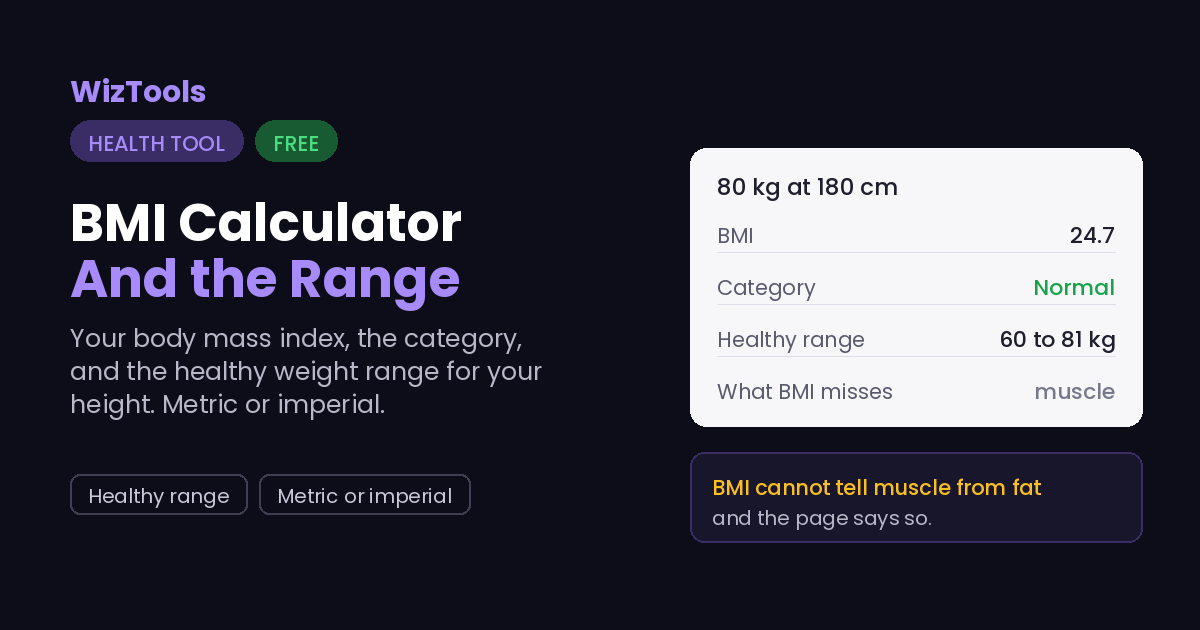
Body mass index divides your weight in kilograms by the square of your height in metres. Under 18.5
is underweight, 18.5 to 24.9 is the normal range, 25 to 29.9 is overweight, and 30 or more is obese.
It is a quick screen built for whole populations, which is exactly why it is rough for one person.
The same BMI can mean very different things. Because it uses only height and weight, a lean
athlete carrying heavy muscle and someone carrying excess fat can share a BMI. It also reads
differently across ages and builds. Treat it as a starting point, next to your waist, how you
feel, and what a doctor tells you.
The healthy weight range comes from the same formula. It is simply the weights that put a
normal BMI on your height, so it is a band rather than a single target. This tool shows that band,
and how far above or below it you are, in whichever units you have chosen.
Where Your Input Goes
Nowhere. And you can check that yourself.
Your height and weight are worked out in your browser and never sent anywhere.
It is all done by your own browser. Press F12, open the Network tab, and use the tool:
the page fetches its own code and nothing else. Or load the page, turn off your wifi, and
carry on. It still runs, because there was never a server in the middle.
How to Calculate Your BMI
A few steps, and nothing is uploaded.
1
Pick metric or imperialOne switch flips every field between centimetres and kilograms and feet and pounds.
2
Enter your heightIn centimetres, or in feet and inches. Nothing is uploaded.
3
Enter your weightIn kilograms or pounds; the result updates as you type.
4
Read your BMI and rangeYour BMI, its category, and the healthy weight range for your height.
What to Know About BMI
Including the things this tool cannot do.
BMI is weight over height squared, nothing more. It is a screen, not a diagnosis, and it cannot tell muscle from fat. A very muscular person can read overweight while being lean, and a frail person can read normal while carrying little muscle. Use it as a rough guide.
The healthy range is a band, not a single number. Any weight that puts a BMI of 18.5 to 24.9 on your height is inside it. This tool shows that band and how far above or below it you are, so you have a target range rather than one exact figure.
It reads differently across people. BMI cut-offs were drawn from mostly adult, mostly European data, and they fit older adults, some ethnic groups, athletes and growing children less well. For children and teenagers, a percentile chart is the right tool, not this one.
Waist matters too. Where fat sits changes the risk, and BMI cannot see that. A waist measurement, or waist-to-height ratio, adds what BMI misses. Treat BMI as one number among several, not the whole picture.
Key Features & Capabilities
What this tool does, and what it deliberately does not.
BMI and categoryYour body mass index and the range it falls in.
Healthy weight rangeThe band of weights that give a normal BMI for your height.
Metric or imperialCentimetres and kilograms, or feet and pounds, at one switch.
As you typeThe result updates while you edit, with no run button.
History and savedRecent results and named setups, on this device only.
Nothing uploadedYour height and weight stay in the browser.
About the BMI Calculator
Body mass index is the most common way to put a single number on body size. It divides your weight by the square of your height, and compares the result against ranges that mark underweight, normal, overweight and obese. This calculator does that in either metric or imperial units, and also shows the healthy weight range for your height so you have something to aim at.
Its strength is also its weakness: it needs only two numbers, which makes it quick and universal but blind to everything else. It cannot tell muscle from fat, it does not know where fat sits, and it was drawn largely from adult European data, so it fits some people better than others. The tool says this plainly rather than dressing a rough screen up as a verdict.
Everything runs in your browser. Your height and weight are never uploaded, there is no account, and the calculator keeps working with the wifi off. Use it to see roughly where you sit and to track change over time, and read it alongside your waist, your activity, and a professional opinion rather than on its own.
Frequently Asked Questions
What BMI measures, what it misses, and the healthy range.
It is your weight in kilograms divided by the square of your height in metres. For imperial figures the tool converts pounds and feet to metric first, so the result is the same either way. A BMI of 18.5 to 24.9 is the normal range.
Not necessarily. BMI is a rough screen that cannot tell muscle from fat or see where fat sits. Someone can be inside the normal range and unfit, or outside it and healthy. Use it with other measures like your waist and your activity, not on its own.
Because it uses only height and weight. Athletes with a lot of muscle often read overweight, while people with little muscle can read lower than their body fat suggests. Older adults and some ethnic groups also fit the standard cut-offs less well.
No. Children and teenagers should use age and sex percentile charts, not adult BMI categories, because healthy ranges change as they grow. This tool is for adults.
No. Your height and weight are worked out in your browser, with history and saved setups on this device only. You can confirm it in the Network tab or by working offline.