
WizTools123
WizTools123
Free Online Tools

Tool Categories


Audio Tools New Tool

Free Online Audio Loop Maker With Seamless Joins

Loop an audio file free without uploading it. Repeat it a set number of times, or fill a length and let the count be worked out. The click at each join is removed by snapping both ends to a zero crossing, which keeps the length exact, or by crossfading the repeats into each other.
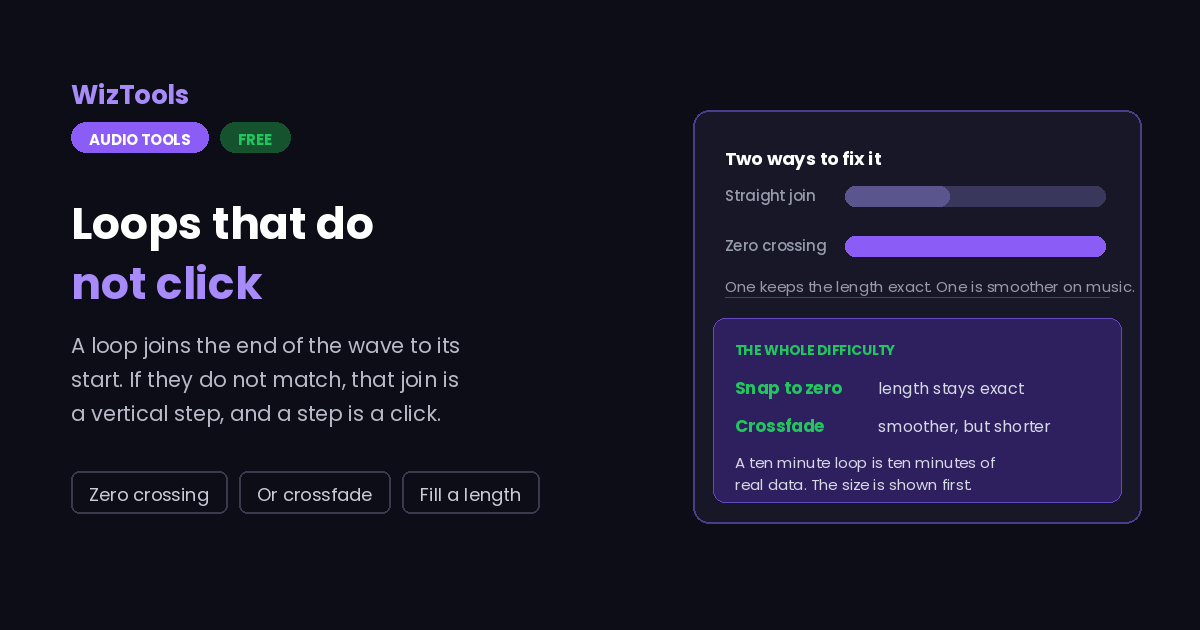
Free Forever Nothing Uploaded Joins That Do Not Click Fill A Length
Free Online Audio Loop Maker With Seamless Joins
Share this tool
Advertisement Slot (Top Banner) Google AdSense Unit • Responsive Banner
Drop an audio file here to loop it Repeat it a number of times, or fill a length. Nothing is uploaded. Select an Audio File MP3, WAV, M4A, OGG, FLAC and more • best under 25 minutes • nothing is uploaded
The shape of the file appears here, with the piece being looped shaded on it.
0:00.000 / 0:00
How many times
Including the first time through.
The join between repeats
Which part to loop
Leave these alone to loop the whole file. Set them to loop just a bar, a phrase or a room tone out of a longer recording.

Output
Only used when the output is WAV. The compressed formats have their own.
.mp3

Your looped file

These files only exist in this tab. Save the ones you want before you close the page, because there is no copy of them anywhere else.

Buy Us A Coffee

Enjoying WizTools123? Help keep our server infrastructure 100% free and open for everyone.

Buy Us A Coffee
Sponsored Content (Below Tool) Google AdSense Placement

How to Loop Audio

Choose the piece, choose how many, and deal with the join.

1
Drop the file in The whole thing is the loop unless you mark a piece of it further down the page.
2
Say how many times, or how long A count if you know it, or a length to fill, which works out the count for you and handles the last repeat.
3
Deal with the join Snapping to a zero crossing is the default and keeps the length exact. A crossfade is smoother on music and makes the result a little shorter.
4
Run it and take the file The finished length and size are shown before anything happens, which matters when you are filling ten minutes.

Why Loops Click, and How to Stop It

The whole difficulty is in one place.

A loop clicks when its two ends do not match. Sound is a wave; if it is at plus half at the end and minus half at the start, the join is a vertical step, and a vertical step is a click. That is the entire problem, and everything on this page about joins exists to solve it.
Snapping to a zero crossing is the option that keeps the length exact. The cut is nudged by a few thousandths of a second to a point where the wave is passing through zero, so both ends meet at the same value. It costs almost nothing and is the right default.
A crossfade always makes the result slightly shorter. The repeats overlap, so a fifth of a second of crossfade across twenty repeats removes about four seconds. That is what a crossfade is, but it surprises people, so the figure is shown.
A long loop makes a large file. Ten minutes of MP3 at 192 kbps is about fourteen megabytes whether it repeats or not, because the file has no idea the content is the same. If the player can loop by itself, a short file is the better answer.
The work happens on your own machine. Your file is opened by this page, not sent anywhere. That is why there is no upload bar, no queue and no waiting for a server. It is also why a long recording leans on your own memory: nothing is being done for you somewhere else.
Most of what this page does needs no download at all. Your browser already has a full audio engine in it, and that is what does the work. A thirty megabyte encoder is only fetched if you ask for MP3, M4A, OGG or FLAC at the end. Ask for WAV and nothing is downloaded, ever.
Length matters more than file size here. A browser opens sound at full detail, which works out at about twenty one megabytes of memory for every minute of stereo. A three minute song is nothing. A two hour recording is a different matter, and this page tells you where you stand the moment you pick a file.
MP3, M4A, OGG and Opus throw information away, every time. Opening one and saving it again is a second pass of that, so the result is always slightly worse than the original even if you changed nothing. Where it matters, take WAV or FLAC out of this page instead.

Key Features & Capabilities

What this tool does, and what it deliberately does not.

Nothing uploaded The whole thing happens in the page, however long the result is.
Seamless joins, two ways Snap to a zero crossing to keep the length exact, or crossfade for music where a hard join still shows.
Fill a length Say ten minutes and the repeat count is worked out, with a choice of how the last one ends.
Loop part of a file Mark a bar, a phrase or a stretch of room tone out of a longer recording and loop just that.
Shows the result first Finished length and rough file size before you run it, which matters at ten minutes and above.
WAV downloads nothing Looping needs no encoder at all. One is fetched only for the compressed formats.

About the Audio Loop Maker

Making something repeat sounds like the least interesting job on this site, and then you do it and there is a click at every join. That click is the whole subject, and it comes from something very simple: sound is a continuous wave, and a loop joins the end of the wave to its beginning. If the wave happens to be halfway up at the end and halfway down at the start, the join is a vertical jump, and a vertical jump in a waveform is exactly what a click is.

There are two good answers and this page offers both, because they suit different material. The first is to move the cut slightly. Anywhere in the file there are points where the wave passes through zero, usually only a few thousandths of a second apart, and if both ends of the loop are placed on such points they meet at the same value and there is nothing to hear. This costs almost nothing, changes the length by a few milliseconds at most, and is the right default. It is particularly the right choice when the length has to stay exact, such as a drum loop that must be precisely two seconds.

The second answer is a crossfade: overlap the end of one repeat with the start of the next so one fades out as the other fades in. This is what music loops do, because on sustained material a hard join still shows even when the ends match in value. The cost is that the result gets shorter with every join, and enough people are surprised by that to make it worth stating in numbers on the page rather than in a footnote.

The other half of the page is about how many repeats you want, and there are two ways people ask for that. Some know the count. Others want to fill a duration: ten minutes of rain to sleep to, an hour of room tone for a video edit. The second way needs the count worked out, plus a decision about what happens at the end, because the last repeat rarely lands exactly on the target. It can play out past the target, be cut off precisely on it, or fade, and none of those is right for every case.

One practical warning. A looped file has no idea it is repeating: ten minutes of audio is ten minutes of data. As an MP3 at 192 kbps that is around fourteen megabytes. If whatever is going to play it can loop on its own, a five second file is a much better answer than a ten minute one, and the size is shown on this page before you commit to the larger option.

Frequently Asked Questions

Repeats, lengths, seamless joins and file sizes.

Drop it here, say how many times you want it to play, and press the button. The repeats are written into a single file, so it loops wherever it is played rather than relying on the player to loop it.

Because the wave does not end where it started. If the last sample is well above zero and the first is well below it, the join is a vertical step and a vertical step is heard as a click. The default setting nudges both ends to a point where the wave passes through zero, which removes it.

Snapping to a zero crossing moves the cut by a few thousandths of a second so the ends match, which keeps the length exact. A crossfade overlaps the end of one repeat with the start of the next, which is smoother on music but makes the result slightly shorter each time.

Yes. Switch to filling a length, type ten minutes, and the repeat count is worked out for you. You can also choose whether the last repeat plays out, is cut off exactly on time, or fades.

Yes, and it is worth knowing before you make it. Ten minutes as an MP3 at 192 kbps is around fourteen megabytes, whether or not the content repeats, because the format has no concept of repetition. If whatever is playing it can loop on its own, a short file is better.

Yes. Mark the start and end of the piece near the bottom of the page, using the two buttons to take the times from the player. Only that piece is repeated.

Other Audio Tools

Advertisement Slot (Bottom Banner) Google AdSense Unit • Responsive Banner