
WizTools123
WizTools123
Free Online Tools

Tool Categories


Text Tools New Tool

Free Online Text Truncator, Cut Text To A Length Limit

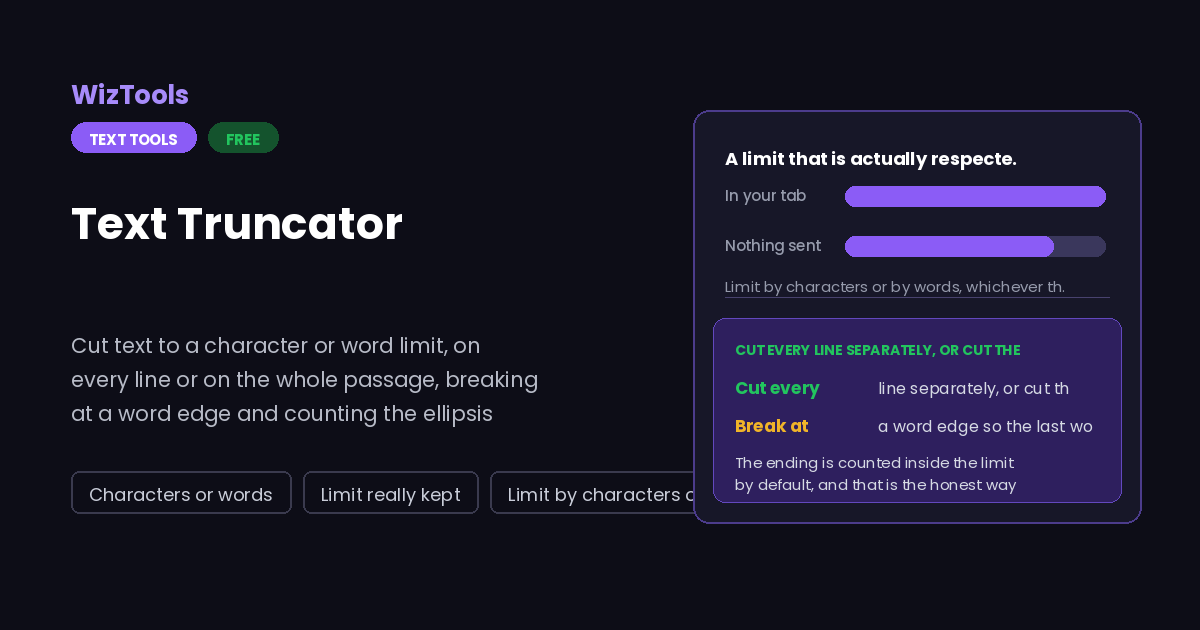
Trim text down to a length limit in your browser. Set the limit in characters or words, choose whether every line is cut separately or the whole passage is cut once, and decide whether the cut lands exactly on the count or moves back to the last word. The ellipsis is counted inside the limit, so the result really does fit.
Free Forever Nothing Uploaded Characters or words Limit really kept
Free Online Text Truncator, Cut Text To A Length Limit
Share this tool
Advertisement Slot (Top Banner) Google AdSense Unit • Responsive Banner
Text Truncator Everything happens in this tab. Nothing you paste is sent anywhere.
Your text
0 characters 0 words 0 lines
Shortened
0 characters 0 lines
The limit
Apply it to
Where to cut
Also

0 lines 0 shortened 0 longest result 0 characters removed

Buy Us A Coffee

Enjoying WizTools123? Help keep our server infrastructure 100% free and open for everyone.

Buy Us A Coffee
Sponsored Content (Below Tool) Google AdSense Placement

How to Cut Text To A Length Limit

A few steps, and nothing is uploaded.

1
Paste the text A single passage or a list of lines. A .txt file can be dropped onto the box instead.
2
Set the limit Type the number and choose characters or words. The common limits menu fills in the number for titles, descriptions and posts.
3
Choose line by line or all at once Line by line is for lists where every entry has its own limit. The whole text as one piece is for a single description or summary.
4
Check the longest result and copy The counter shows the longest line in the result. If the limit is being kept, that number is at or under your limit.

What to Know About Cutting Text To Length

Why a character is not always one character, and where the cut lands.

The ending is counted inside the limit by default, and that is the honest way round. If you ask for 280 characters and add three dots, the text is cut at 277 so the finished line is 280. Switch it off only when the system you are feeding counts the body separately from the ellipsis, which is rare.
A character here is a Unicode code point, not a byte and not always what you see. A plain letter is one, an accented letter may be one or two depending on how it was typed, and an emoji is often two. Twitter and SMS each count slightly differently, so treat the number as very close rather than identical to theirs.
Cutting back to the last word can remove a lot. A limit of forty that lands in the middle of a long word moves back to the previous space, which might be several characters earlier. That is the trade for not leaving half a word, and it is why the result can be shorter than the limit.
Tidying removes the punctuation left dangling at the cut. Ending a sentence on a comma or an opening bracket reads as a mistake, so a trailing comma, semicolon, colon, dash or open bracket is taken off before the ellipsis is added. A full stop is kept, because a sentence that happens to end there is finished.
Lines already under the limit are not touched at all. No ellipsis is added to them, because nothing was removed. The shortened counter tells you how many lines were actually cut.

Key Features & Capabilities

What this tool does, and what it deliberately does not.

Characters or words Both units, because a style guide for titles counts characters and a brief for copy counts words.
The limit is kept The ellipsis is counted inside the limit by default, so the finished text fits the box you are putting it in.
Word safe cutting The cut moves back to the last whole word, or lands exactly on the count if that is what the data needs.
Line by line Cut a whole list where every entry has its own limit, which is how product names and headings usually arrive.
Common limits ready Sixty for a title, one hundred and sixty for a description, two hundred and eighty for a post.
Nothing is uploaded Unpublished copy and client text are cut in this tab and never sent anywhere.

About the Text Truncator

Length limits are everywhere and almost all of them are enforced by something that simply refuses the text. A page title over sixty characters is cut by the search engine in a place you did not choose. A description over a hundred and sixty is cut mid word. A post over the limit is not posted at all.

Cutting by hand is quick for one line and awful for a hundred, and the counting is where it goes wrong. People add the three dots after cutting to the limit and wonder why the form still complains. That is the one thing this page is careful about: the ending is part of the limit unless you say otherwise.

Word based limits exist for a different world. Briefs, abstracts and academic submissions count words, and a word count ignores how long the words are. Both units are here because the limit you have been given is not negotiable, and converting between the two in your head is guesswork.

Frequently Asked Questions

Limits, word edges, ellipsis and lines that are already short.

Two reasons. The cut moves back to the last whole word, which can be several characters earlier, and the ellipsis is counted inside the limit. Switch "Where to cut" to exactly on the count if you need every character used.

Most emoji count as two, because that is how they are stored. Some platforms count them as one and some as more, so if you are close to a hard limit on a social platform, check in that platform before publishing.

Yes, that is what "each line on its own" does. Every line is measured and cut separately, and lines already short enough are left exactly as they are.

It removes a comma, semicolon, colon, dash or opening bracket left at the cut before the ellipsis is added, because text ending on one of those reads as broken. A full stop is left alone.

Very close. A word here is a run of characters between spaces, so a hyphenated word counts as one and a number counts as one. Word processors mostly agree, but they differ on a few edge cases like text in brackets.

Other Text Tools

Advertisement Slot (Bottom Banner) Google AdSense Unit • Responsive Banner